
Rejoice in hope; endure in suffering; persist in prayer. Romans 12:12
There I was again, praying the same prayers that I’ve prayed countless times. Only recently, while praying them, a silent cry was simultaneously arising from my heart, “God, can You hear me?!”
Of course, I knew from Scripture and plenty of previous experience with the Lord that the answer was yes—and that my prayers were in alignment with His will. But the enemy seizes seasons of waiting or delay to tempt us to question what we know. Since Scripture reveals there truly are things that can hinder our prayers, we always want to seek wisdom and understanding when prayers seem unheard or unanswered. So we continually pray for revelation in this regard.
Delays Are Not Denials
A day or two later, as I listened to my Bible chapters for the day, I felt the Lord was highlighting numerous things from Luke 18—beginning with Jesus’ admonition to always pray and never give up.
18 Also [Jesus] told them a parable to the effect that they ought always to pray and not to turn coward (faint, lose heart, and give up). 2 He said, In a certain city there was a judge who neither reverenced and feared God nor respected or considered man. 3 And there was a widow in that city who kept coming to him and saying, Protect and defend and give me justice against my adversary. 4 And for a time he would not; but later he said to himself, Though I have neither reverence or fear for God nor respect or consideration for man, 5 Yet because this widow continues to bother me, I will defend and protect and avenge her, lest she give me intolerable annoyance and wear me out by her continual coming or at the last she come and rail on me or assault me or strangle me.
6 Then the Lord said, Listen to what the unjust judge says! 7 And will not [our just] God defend and protect and avenge His elect (His chosen ones), who cry to Him day and night? Will He defer them and delay help on their behalf? 8 I tell you, He will defend and protect and avenge them speedily. However, when the Son of Man comes, will He find [persistence in] faith on the earth? Luke 18:1-8 AMPC
He’s used this passage to minister to my heart through the years, though I’ve admittedly still wrestled with the fact that His definition of not deferring or delaying help can feel painfully different from mine…
Later that same day, as I listened to an audiobook, there was Luke 18 and the persistent widow AGAIN…
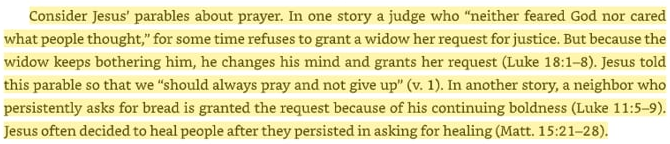
I had actually been a day behind schedule in my New Testament chapters that day, but now I felt like my delay was somehow the Lord’s perfect timing—orchestrating for me to hear about the persistent widow twice in the same day to confirm He was truly emphasizing this account. These confirmations were a needed reminder, not only that God hears, but that delays are not denials.
Shameless Audacity
In the account from Luke 11 of the neighbor requesting bread, referenced in the excerpt from “Boundaries,” Jesus said, “I tell you, although he will not get up and supply him anything because he is his friend, yet because of his shameless persistence and insistence he will get up and give him as much as he needs.“ The NIV says, “… yet because of your shameless audacity he will surely get up and give you as much as you need.“ (Luke 11:8 – full passage at the end of the blog)
Immediately afterward, Jesus counsels them, “So I say to you, Ask and KEEP ON asking and it shall be given you; seek and KEEP ON seeking and you shall find; knock and KEEP ON knocking and the door shall be opened to you. For everyone who asks and KEEPS ON asking receives; and he who seeks and KEEPS ON seeking finds; and to him who knocks and KEEPS ON knocking, the door shall be opened.” (Luke 11:9-10)
(As mentioned in previous blogs, though some translations only say ask, seek, and knock, the AMPC more accurately translates the present active Greek verb tense denoting the continuous action of KEEP ON asking, KEEP ON seeking, KEEP ON knocking.)
Shameless audacity. Shameless persistence and insistence.
What a contrast to how many have been taught to approach the Lord in prayer. On one side of the spectrum, some have been taught that when we’ve asked for a time, but not seen the desired answers, to surrender the request—concluding it must not be the Lord’s will. On the other end of the spectrum, some have been taught they should only ask once, and then cross the line of faith to believe they have received in order to see the answer’s arrival. Still others have been taught to not even ask at all, but to only speak to “the mountain,” prophesy to “the bones,” and declare God’s promises. While surrendering a request, believing we have received, speaking to mountains, prophesying to bones, and declaring promises can all be valid and supported with Scripture depending on the situation, Jesus is revealing another principle of prayer that can’t easily be reconciled with the way these are often taught.
This Greek word anaideia (ἀναίδεια) can also be defined as importunity – meaning “troublesomely urgent: overly persistent in request or demand.” For this reason, this form of prayer is sometimes referred to as “importunate prayer“ or “the prayer of importunity.”
Biblical lexicons reveal that “shameless,” in this context, implies an unyielding boldness that refuses to let social constraints stop an urgent request—a freedom from the fear of embarrassment, with a total disregard for the conventional etiquette that usually causes people to politely back down.
“audacity implies a disregard of restraints commonly imposed by convention or prudence.” (definitions in quotes from Merriam-Webster dictionary)
As we seek to strike the right balance of both humility and boldness in prayer, these descriptions might initially feel lacking in humility and excessive in boldness. But Jesus not only invited us to pray this way—He gave this as a key to receiving the answers we need. Understood correctly, this won’t lead to disrespect or dishonor, but to the fervency of persevering faith.
I love that Luke 18 starts with the account of the persistent widow and ends with the account of Blind Bartimaeus, who also demonstrated this exact same kind of persistent tenacity and shameless audacity. He knew Jesus was the only one with the power to meet his desperate need and was unwilling to let the opportunity pass him by. He cried out in both boldness and humility. And when everyone around him tried to convince him to stop, he cried out even more!
38 And he shouted, saying, Jesus, Son of David, take pity and have mercy on me! 39 But those who were in front reproved him, telling him to keep quiet; yet he screamed and shrieked so much the more, Son of David, take pity and have mercy on me! Luke 18:38-39
And Jesus stopped. He listened. And the man was healed.
We also see persistent tenacity and shameless audacity in Jairus, the woman with the issue of blood who risked her life to press through to Jesus, the Canaanite woman who kept seeking deliverance for her daughter even when initially ignored and then potentially insulted by Him, the four friends who ripped open a roof to lower their paralyzed friend to His feet—and others (Mark 5:22-43, Matthew 15:21-28, Luke 5:17-26).
Fellowship vs. Formulas
So how do we know when to conclude a request isn’t God’s will and to surrender it…
versus when we should stop asking and start thanking because we’ve crossed the line of faith to believe we have received…
versus when we should speak to “the mountain,” prophecy to “the bones,” and declare the promises…
versus when we should keep on persistently asking, seeking, and knocking—crying out day and night?
The wrestle is real, with no formulas—only intimate relationship with the Lord—to resolve it.
Each one of these responses can be Biblical. Each can be the obedience of faith. And each requires abiding in communion with the Lord in His Word and through His Spirit to guide us to the right posture and principles of prayer and warfare for our battles.
Often, multiple strategies should be employed—like Elijah, who combined prophetic declaration that the rain was coming with persistent prayer until it came (1 Kings 18:41-46). Having promises and prophecies from the Lord in an area should at the least rule out the first option of resignation and surrender of our request—though we may still have to surrender our specific idea and timing of the fulfillment. And we may still need divine wisdom to see them fulfilled—wisdom we might miss if we rely only on faith formulas rather than intimate relationship with the Lord and Spirit-led guidance. In my experience, His counsel to persevere, persist, endure, and not give up is more common than we’d like, even in the areas of speaking to mountains, prophesying to bones, declaring promises, and believing we have received.
Outlasting the Devil
I had sent the first two encouraging words from Luke 18 to some family and friends the following Monday. But the Lord wasn’t done—HE persisted…
The next night, after asking Him to lead us to something to pray through in John Ramirez’s book “Fire Prayers”, Jesse opened to a part of the book that didn’t have the typical prayers as in most chapters, but instead was just laying the groundwork for the warfare prayers in the rest of the book. I was overwhelmed when I realized the Lord was highlighting the persistent widow AGAIN!
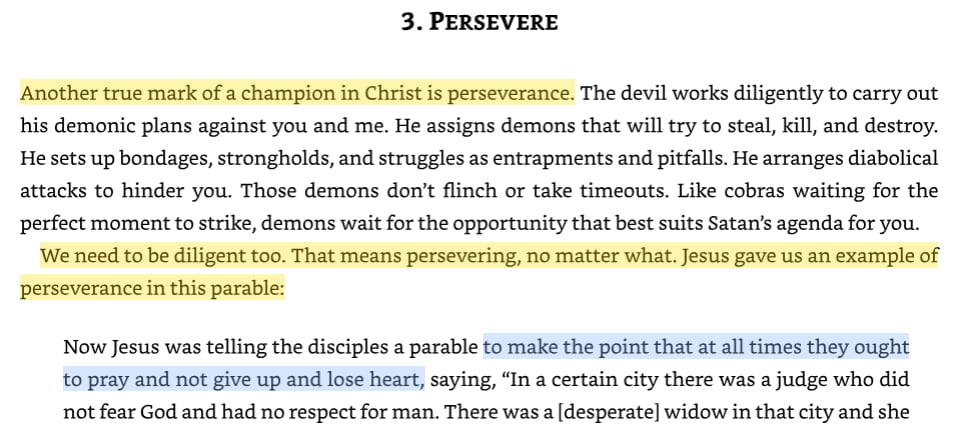
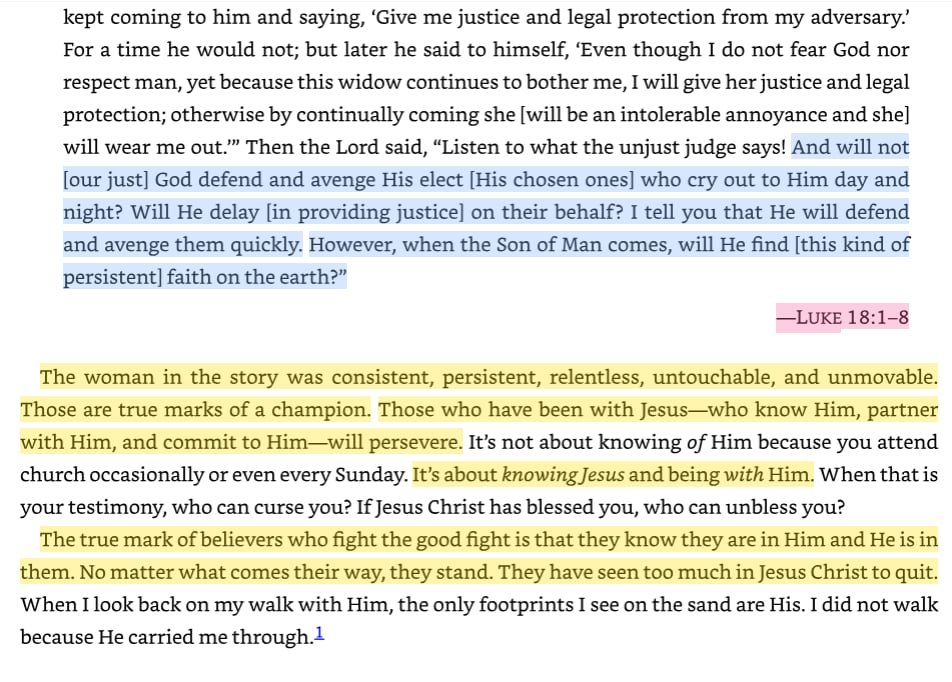
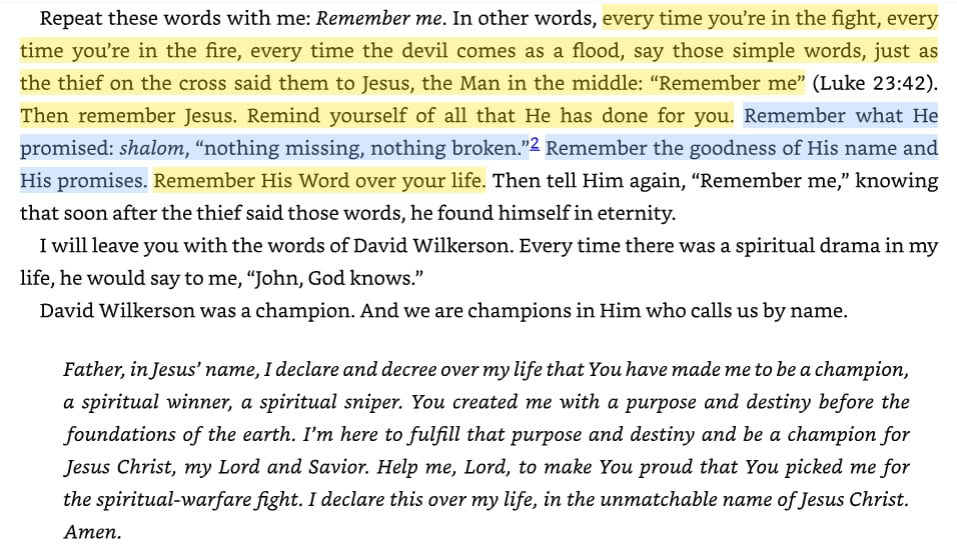
Toward the end of the excerpt, David Wilkerson’s words—”God knows”—were also the continuation of a theme the Lord had been emphasizing for a few months. In a conversation with a loved one, I had texted, “God sees. He hears. He knows. And He cares.” A few days later, our pastor said the exact same thing, word for word, in his Sunday sermon. The context surrounding this in his message was also deeply relevant for the person I’d said it to, so I recorded that clip and sent it to them. It was such a meaningful confirmation for them—and for me. The Lord had continued emphasizing that theme since, and now was weaving it together with the Luke 18 theme of persevering.
Flipping the Script
The Greek word translated in Luke 18 as some version of not giving up is ekkakeō (ἐκκακέω, -ῶ), meaning “to be utterly spiritless, to be wearied out, exhausted” (Strongs G1573). With a related entry (ἐγ-κακέω, ῶ) defined as “to be weary in anything, or to lose courage, flag, faint.”
Unfortunately, our adversary’s goal to kill, steal, and destroy is often pursued through this long-game strategy of wearing us out. (Daniel 7:25, John 10:10). Hopefully, being aware of this can help us better resist it. So the Scriptural encouragement to “not become weary in doing good,” which includes our faithful prayers, is vital if we want to overcome (Galatians 6:9).
And let us not lose heart and grow weary and faint in acting nobly and doing right, for in due time and at the appointed season we shall reap, if we do not loosen and relax our courage and faint. Galatians 6:9
Interestingly, the unjust judge in Luke 18 said he would give the persistent woman justice so that she would not wear him out… Rather than allowing ourselves to be worn out by the enemy, we need to flip the script and determine that we’re going to wear him out instead with our persistent and persevering fight of faith.
Putting the “Severe” in Persevere
Persevere – “to persist in a state, enterprise, or undertaking in spite of counterinfluences, opposition, or discouragement.”
Perseverance – “continued effort to do or achieve something despite difficulties, failure, or opposition…”
Wondering whether the word persevere, might have originally come from a word that meant to endure through severe circumstances, I checked the etymology.
“Etymology – Middle English perseveren, borrowed from Anglo-French parseverer, perseverer “to last, endure, persist in spite of opposition,” borrowed from Latin persevērāre “to persist in a course of action or an attitude in spite of opposition, KEEP ON, (of a condition) continue, last,” from per- per- + -sevērāre, verbal derivative of sevērus “stern, austere, severe“
“continue applies to a process going on without ending.”
“last … may stress existing beyond what is normal or expected.”
“persist suggests outlasting the normal or appointed time and often connotes obstinacy or doggedness.”
“endure adds an implication of resisting destructive forces or agencies.” (definitions from Merriam-Webster Dictionary)
Apparently, the “severe” (sevērus) in the original language for persevere was not in reference to the severity of the PROBLEM one was enduring, but instead was actually a reference to the severity of the PERSON who was enduring! It meant this person was “strict, serious, grave, austere, and severe” in their determination to stick with a task and not quit. It later evolved to our more modern use of sticking with something through harsh, intense (or we could say severe) circumstances. But the “severe” in persevere describes the person rather than the problem.
According to this understanding, I believe it’s appropriate to say that persevering requires becoming SEVERE in order to overcome SEVERE situations.
To be clear, this is not an encouragement to abandon the fruit of the Spirit and give place to the flesh or the enemy by becoming severe towards people! It’s an encouragement to become strict, serious, severe—fiercely determined—in our internal resolve to overcome—and in our commitment to put on the whole armor of God and fight spiritual warfare against our enemies in the spiritual realm. In order to persevere to the end, our INTERNAL severity and determination to overcome must surpass the EXTERNAL severity of the enemy’s obstacles and opposition.
Looking Unto Jesus—The Author and Finisher of Our Faith
While we might feel stirred up and fanned into flame with this kind of fierceness at times, the Lord understands the temptation to grow weary when battles drag on long-term and seem unyielding and unending. Though it’s encouraging to hear the Lord’s promises that HE WILL defend, protect, and avenge (speedily…)—and that WE WILL eventually receive, find, and see doors open—at the same time, it can still be discouraging to receive another message that more persisting, enduring, and persevering are needed before we get there! This is especially true for those who have been receiving this kind of message for many years. When we’re battling weariness, or on the verge of giving up, we might be tempted to believe we’re so depleted from the battles that we don’t have what it takes to rally this kind of fight of faith again that we need in order to “keep on”.
But thankfully, we don’t have to find this strength and determination in our flesh.
In the Fire Prayer excerpt above, John Ramirez encouraged us to “remember” certain things about Jesus. I believe it’s vital to expound on that point. We often hear the passage about Jesus being the Author and Finisher or Perfecter of our faith, but we may hear it quoted out of its fuller context so often that we easily forget the point being made in context. Just before the author tells the church to look away from distractions to Jesus, he encourages believers, “…let us run with patient endurance and steady and active persistence the appointed course of the race that is set before us….” The famous instruction that follows—to look to Jesus, the Author and Finisher of our faith—is specifically intended to help us be able to successfully run our race with endurance, persistence, and perseverance all the way to the finish (completion, perfection)—by looking to the FINISHER and His example of persevering to the finish! Jesus not only begins (authors), He finishes (completes, perfects). Therefore the author of Hebrews says we must look to Jesus’ example of endurance – remembering all He suffered and endured at the hands of the enemy in order to persevere all the way to the victorious finish – “…so that you may not grow weary or exhausted, losing heart and relaxing and fainting in your minds.” (Hebrews 12:1-3) When we remember all He endured for us, it should help renew our commitment to endure all the way through for Him.
“The word ‘endured‘ is from the well-known Greek word hupomeno. It is a compound of the words hupo and meno. The word hupo means under, and the word meno means to abide or to stay. When the two are compounded, the new word portrays a person who is under some type of incredibly heavy load but who refuses to stray from his position because he is committed to his task. Regardless of the load, opposition, stress, or weight that comes against him, he is not going to move. He is going to stay put in his spot and not surrender it to anyone for any reason! This word depicts one who refuses to bend, break, or surrender because he is convinced that the territory, promise, or principle under assault rightfully belongs to him. It denotes a refusal to give up. One expositor has rightfully translated hupomeno as staying power. However, my favorite translation of the word hupomeno is hang-in-there power!”
(excerpt from Sparkling Gems from the Greek, Vol II, April 3, by Rick Renner)
If you’ve heard us respond “hanging in there,” when asked, “How are you?” in recent years—this is our Biblical explanation for why…
But we can look to Jesus as the Finisher of our faith—not only through His example, but also through His empowerment. Though Jesus’ flesh was subject to weariness, we know God does NOT grow faint or weary. And He is not only for us and with us, He is IN US. We can claim His promise to give strength to the weary and increase the power of the weak. We can come to Him to renew our strength, as He’s promised to do for all who continually wait on and put their confident expectation of good—their hope—in Him (Isaiah 40:26-31). And we can steel ourselves in the truth that GREATER is HE who is IN US than anything coming against us (I John 4:4).
May the Lord direct your hearts into God’s love and Christ’s perseverance. II Thessalonians 3:5
“I Can Do This All Day”

During the days of polishing this blog, we watched Captain America: The First Avenger, which we probably hadn’t seen in around 15 years and remembered very little of. You may recall that when Steve Rogers (who later became Captain America) was still small and frail, he took a beating from a bully for standing up for what was right. Yet time after time when he was knocked down, he stood back up again to face the aggressor, eventually saying with persistent tenacity and shameless audacity, “I can do this all day.” This became a famous phrase that resurfaced later in the same movie and then echoed throughout other Captain America and Avenger films. Steve demonstrated the inner severity and determination to outlast, wear out, and overcome the external severity of what was coming against him—even when he didn’t have the natural strength in his flesh to back up the strength of his soul and spirit. But after being infused with the super-soldier serum, his physical strength was able to support his strength of soul and spirit. What a profound picture this was of this message the Lord has been emphasizing in these past weeks.
Admittedly, when we’re deep in the trenches of prolonged suffering, adopting this resilient and resolute attitude of “I can do this all day” is the absolute antithesis of how we actually feel. Instead, we may feel that we’re at the end of our rope and can’t endure what we’re going through another day… or hour… or moment. Additionally, we may be concerned that taking this kind of defiant stance against our aggressors in the spiritual realm could taunt and provoke them—inviting further backlash. We certainly want to avoid the mistake Jude and Peter warned about of engaging these forces without wisdom and being destroyed (Jude v.8-10, II Peter 2:10-12). Yet, we also want to avoid neglecting the authority and armor God has given us to overcome them (Luke 10:19, Ephesians 6:10-18). Holding these seemingly competing concerns simultaneously brings us back to the essential tension of learning to find the proper balance of boldness and humility—toward God, toward others, and even in our warfare against the enemy—in order to avoid dangerous ditches on both sides of the road.
Ultimately, humility causes us to recognize that in our flesh, we’re woefully outmatched by the enemy (as Steve Rogers was initially). In contrast to the popular mantra, “You’ve got this,” humility makes us aware that in and of ourselves, we don’t have what it takes. We’re utterly dependent on abiding in Christ and allowing Him to abide in us. It reminds us that apart from Him, we can do nothing and will wither and die (John 15:4-8). But as we remain in vital union with Him, the life-giving Super-serum from the Vine will continue flowing to, in, and through us—infusing us with everything we need.

Then our ability to stand back up and say, “I can do this all day” comes not from taunting provocation, but from the same bold humility as Paul’s declaration, “I can do all things through Christ who strengthens me” (Philippians 4:13). It’s a reminder to the enemy, as well as to ourselves, that the unyielding, tireless One lives IN US, and He will not wear out. The empowerment we can draw on through Yahweh in us, Christ in us, His Holy Spirit in us—wielding the very power that created the universe and raised Jesus from the dead—can make us His super-soldiers, equipped with the inner severity required to persevere in the good fight of faith “all day”—until we overcome.
I can do all things [which He has called me to do] through Him who strengthens and empowers me [to fulfill His purpose—I am self-sufficient in Christ’s sufficiency; I am ready for anything and equal to anything through Him who infuses me with inner strength and confident peace.] Philippians 4:13 AMP
Stronger Than The Storm
As I finished writing this, I saw another glimpse of God’s divine orchestration when I realized the shirt I was wearing says, “STRONGER than the storm.” That night He gave us the passage “GREATER IS HE that is in me than the one in the world” during our devotional time. And we’ve received additional confirmations since.
The Lord calls us to Spirit‑empowered severity in prayer, faith, and spiritual warfare—a supernaturally sustained perseverance that can only come from abiding in Him and Him abiding in us.
May He help us pray with persistent tenacity and shameless audacity and never give up when our requests proceed from His Word and will. Knowing that delays are not denials, may we keep on asking, seeking, and knocking until we receive, find, and see the doors open.
May we receive His divine strategies to know which postures and principles of prayer and warfare to employ in our battles.
May we fix our eyes on Jesus, the Finisher, as our example and Source of enduring all the way to a victorious finish.
May we expectantly wait on Him with confidence (hope), allowing Him to renew our strength, so that we will out-persist every persistent battle and wear out the enemy instead of being worn out by him.
May we steel ourselves in the astonishing truth that He lives IN US as an EVER PRESENT Help and that He’s GREATER than anything coming against us, so that we’re truly stronger than the storm and can do all things through Him.
May His fierce determination against the fierce opposition we face—His unyielding resolve against each unyielding obstacle—and His severity against every severe situation rise up within us and carry us through to victory.
I know it’s been such a hard and long season of suffering for many. We’re praying continually and believing for us all to endure and to overcome!
(Additional Scriptural encouragement)
5 And He said to them, Which of you who has a friend will go to him at midnight and will say to him, Friend, lend me three loaves [of bread], 6 For a friend of mine who is on a journey has just come, and I have nothing to put before him; 7 And he from within will answer, Do not disturb me; the door is now closed, and my children are with me in bed; I cannot get up and supply you [with anything]? 8 I tell you, although he will not get up and supply him anything because he is his friend, yet because of his shameless persistence and insistence he will get up and give him as much as he needs. 9 So I say to you, Ask and keep on asking and it shall be given you; seek and keep on seeking and you shall find; knock and keep on knocking and the door shall be opened to you. 10 For everyone who asks and keeps on asking receives; and he who seeks and keeps on seeking finds; and to him who knocks and keeps on knocking, the door shall be opened. 11 What father among you, if his son asks for a loaf of bread, will give him a stone; or if he asks for a fish, will instead of a fish give him a serpent? 12 Or if he asks for an egg, will give him a scorpion? 13 If you then, evil as you are, know how to give good gifts [gifts that are to their advantage] to your children, how much more will your heavenly Father give the Holy Spirit to those who ask and continue to ask Him! Luke 11:5-13 AMPC
26 Lift up your eyes on high and see! Who has created these? He Who brings out their host by number and calls them all by name; through the greatness of His might and because He is strong in power, not one is missing or lacks anything. 27 Why, O Jacob, do you say, and declare, O Israel, My way and my lot are hidden from the Lord, and my right is passed over without regard from my God? 28 Have you not known? Have you not heard? The everlasting God, the Lord, the Creator of the ends of the earth, does not faint or grow weary; there is no searching of His understanding. 29 He gives power to the faint and weary, and to him who has no might He increases strength [causing it to multiply and making it to abound]. 30 Even youths shall faint and be weary, and [selected] young men shall feebly stumble and fall exhausted; 31 But those who wait for the Lord [who expect, look for, and hope in Him] shall change and renew their strength and power; they shall lift their wings and mount up [close to God] as eagles [mount up to the sun]; they shall run and not be weary, they shall walk and not faint or become tired. Isaiah 40:26-31 AMPC

